Quackenbush Air Guns
417-993-5262
9am-6pm Central time No Sunday
calls!!
The .50-caliber Bandit!
A modern big bore air rifle priced for everyone
Part 2
Story and photos by Tom Gaylord
Copyright 2003 Tom Gaylord
 Part
1 - Part 3
Part
1 - Part 3
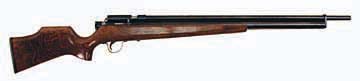
We are looking at the .50-caliber Bandit air rifle made and
sold by Dennis Quackenbush. In Part 1,
we looked at the history of the rifle and its general design.
In this part, we'll get it ready to shoot and also learn something
about the big bores from history.
BIG BORES USE A LOT OF AIR
The way this gun gulps air, you'll want to use a scuba tank
to refill it most of the time. I found our test Bandit used 400-500
psi of air per shot for the first two shots. That begins to taper
off starting with shot three. I felt that four good, powerful
shots were available with each 3,000 psi fill. It's possible to
get more than 10 shots from a fill, but the velocity of the final
one will be down in the 400s. All big bores use a lot of air,
which may surprise those who are used to getting 30-50 good shots
from a smallbore PCP.
The vintage big bore guns from centuries past got more shots from
an air charge than the new breed of screamers because they didn't
do nearly the work with each shot. Big bore airguns of old were
content to push out 60 to 150 foot-pounds of energy, with most
of them hovering somewhere below 125 ft.-lbs. They derived their
energy more from projectile weight than from velocity.
Today's big guns do both - they push big heavy bullets and they
push them fast. Much faster than vintage airguns. The .50-caliber
Bandit sends a 180+-grain ball downrange at a trifle more than
800 f.p.s., depending on the gun and the temperature. A vintage
big bore of the same caliber might have gotten as high as 550
f.p.s. on a good day, but 500 would have been more like it. The
difference between old and new might not seem like much, but it
happens at a point on the performance curve where enormous energy
is required to do just a little more work. The experimental long-barreled
Bandit we tested went a little faster than the 26-inch standard
model, but not enough to warrant an additional six inches of barrel.
Besides their barrels, modern big bores also use seamless hydraulic
tubing for their pressure reservoirs, where the guns of the past
used everything from bored steel cylinders to flasks made of folded
iron with brazed seams. Today's guns work at pressures above 2,000
psi, while most vintage guns never went above 600 psi. This is
one place where Dennis does use the tubing, simply because it
is the best material available.
The reason vintage guns were able to do as much as they did with
such limited air pressure was their combination of extra-long
barrels and timed locks. Instead of the hammer just knocking the
valve open by brute force, the timed lock opens it with a set
of cams that hold it open for a specific length of time. This
allows a larger charge of lower-pressure air to escape. The longer
barrel increases the amount of time the lower-pressure air has
to push on the bullet. Together, these two features (longer valve
time and longer barrel) make it possible for 500 psi to do almost
the same work as 2,000 in a modern slam-fire system with a shorter
barrel.
The Bandit is supposed to be filled to 3,000 psi, but each rifle
will exhibit slightly different performance characteristics. These
characteristics can be discovered by shooting the rifle through
a good chronograph. Experimenters can even remove the receiver's
back cap and substitute a hammer spring of different length to
change performance. Dennis made the spring a standard half-inch
diameter, so you can easily buy bulk replacements at the hardware
store and cut them to length.
 Dennis
now makes an external spring adjuster to allow owners to change
power at will without disassembly. This device opens the way for
much experimentation with an individual rifle. The adjuster replaces the
cap on the action tube by unthreading the cap on the gun and threading this one
in. No tools are needed to set the adjuster. It has a knurled lock ring
that acts as a jam nut that you can work with your fingers. Price $50.
plus shipping.
Dennis
now makes an external spring adjuster to allow owners to change
power at will without disassembly. This device opens the way for
much experimentation with an individual rifle. The adjuster replaces the
cap on the action tube by unthreading the cap on the gun and threading this one
in. No tools are needed to set the adjuster. It has a knurled lock ring
that acts as a jam nut that you can work with your fingers. Price $50.
plus shipping.
Having said that, however, you should also know that these guns
are not nearly as sensitive to small velocity variations as smallbores.
Where 20 f.p.s. is the maximum velocity variation we often look
for in a smallbore over the effective range of shots, with a big
bore it is 100 - or even a bit more. Think about it - if your
.177 group shifts by a half-inch at 40 yards, you really notice
it; with a .50-caliber ball, you'll never see it.
I found that our test gun had four really good shots. I will describe
how it shot in a moment, but first I want to tell you how I conducted
the test.
GETTING READY TO SHOOT
The Bandit is a single-shot bolt-action breechloader with
separate loading and cocking actions. You load by retracting the
bolt. It stays wherever you put it because of the ball-bearing
detent mentioned earlier.
A lead ball is loaded in the trough and pushed home with the bolt
- a crisp, easy operation. Dennis has really calculated everything
to make this a very slick-loading ball-shooter. The safety lug
on the left of the bolt body provides some cramming action to
firmly seat the lead ball in the rifling.
Dennis rifled his barrel very specifically to take a swaged .495
round lead ball. You can buy them at any good gun store that sells
muzzleloading supplies, or they can be bought through the mail.
You can cast your own balls, of course. The only thing you'll
have to watch is the placement of the sprue when loading. Swaged
balls are very uniform and have no sprue, so I recommend using
them for best accuracy.
Now, this is an important point - DON'T USE THE BALLS SIZED .490!
This is an alternative size for some .50-caliber muzzleloaders.
They fit this rifle (very easily, in fact), but you won't get
the gilt-edged accuracy of which the rifle is capable; nor will
you get all the power and accuracy the rifle has to offer. I know,
because I tried them.
When I went to the gun store to get ammunition, they were out
of .495 balls. All they had were the .490 size Dennis told me
NOT to use. But the next stop was the range, so what could I do?
In the next and final part,
we will shoot the Bandit and wrap up this report.
